
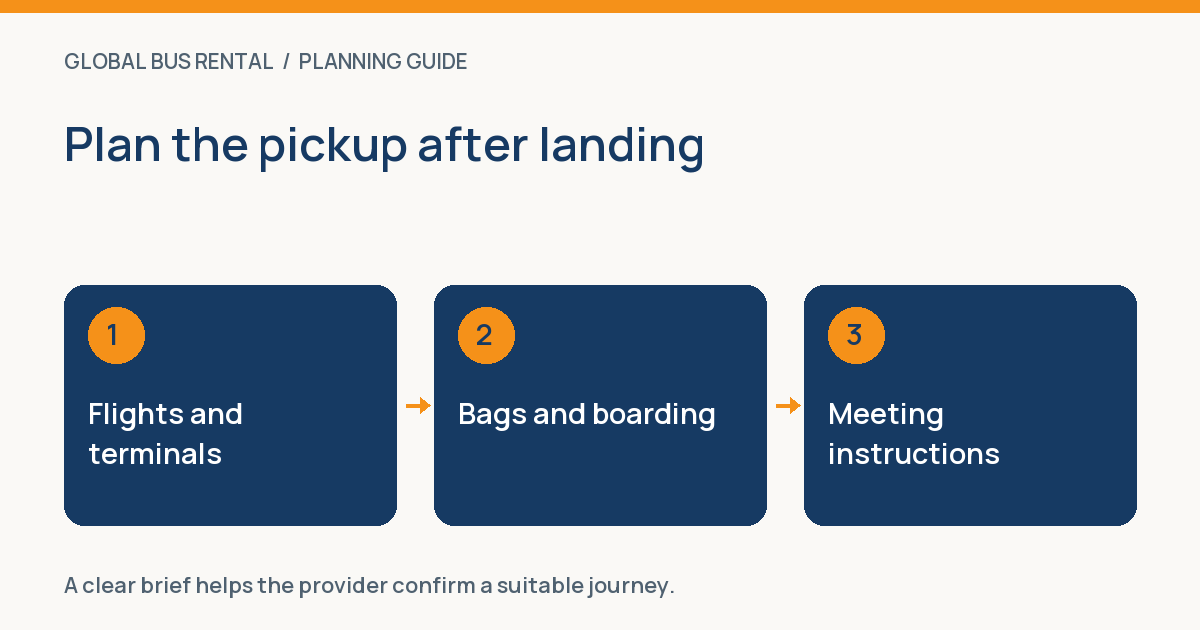
Send flight numbers and a luggage inventory. Confirm the terminal, passenger meeting point, vehicle pickup point and waiting policy as separate details.
Build the arrival brief
Give the provider the travel date, flight number, airport, expected terminal, passenger count and destination address. Include the lead traveller’s reachable phone number and a clear list of luggage. For international groups, check that the contact number will work after arrival.
Distinguish a scheduled landing time from your intended passenger-ready time. The time needed after landing varies, so ask the operator how it plans the collection and handles flight changes. Do not invent a fixed baggage-clearance allowance for every airport or group.
Separate three different locations
The point where passengers meet their organiser may be inside arrivals. The agreed coach pickup can be elsewhere, and the vehicle may wait in a separate holding area until the group is ready. Put all relevant instructions in the passenger message, especially if a representative is meeting the group.
At Heathrow, the airport’s group coach guidance describes designated arrangements and says groups should be ready before their coach is requested. Confirm the current instructions for your booked service rather than directing a private coach to a generic terminal car pickup.
Match the local guide to the collection stage
The Medan arrival guide helps distinguish collection at the airport from collection after an airport-train journey. That decision changes the meeting address. The Ürümqi arrival guide addresses airport identity and current terminal instructions, helping an organiser check an older meeting note. In either case, copy the operator’s confirmed boarding point into the passenger message; a city name or airport name alone is not enough.
Match the vehicle to airport luggage
Airport parties often carry more than day-trip groups. List checked cases, cabin bags, pushchairs and mobility equipment. A vehicle with enough passenger seats may still need a different storage arrangement or may be unsuitable for the full load.
For smaller groups, read the 16-seater luggage guide before confirming minibus hire. For larger parties, request coach hire with the same detailed inventory. Count equipment on the return journey too.
What to agree about delays
- Whether the provider monitors the flight and which flight reference it uses.
- When any included waiting period starts.
- What the lead passenger should do after baggage collection.
- How extra waiting or a changed arrival is assessed and approved.
- Who to contact if a passenger or bag is delayed.
Ask what happens if the group is split across flights. One shared collection may involve a long wait for early arrivals; separate movements may cost more but suit the schedule better. Compare both plans using actual flights and passenger numbers, not just the total group size.
Plan departures backwards from the airport requirement
Use your airline’s current guidance for when travellers should be at the airport. Give that required arrival time to the transport provider, together with the terminal and pickup address. Let the operator assess the road journey and an appropriate contingency for the itinerary.
Include boarding and case loading before the road departure. A hotel pickup time that assumes the coach leaves the instant it arrives is unrealistic for a large group. Ask passengers to be ready at the agreed location with their belongings, rather than starting checkout at departure time.
Keep the arrival message short
Tell travellers which person leads the transfer, where the group gathers and how to contact that person. Ask them to report problems before leaving the terminal independently. The organiser should communicate with the provider once the agreed readiness conditions are met.
Send your flight and journey details to our airport transfer service for assessment, subject to availability and quotation. For a stay in London or another destination, include the exact hotel entrance and any access requirements so the final drop-off is as carefully planned as the airport collection.
Example: a group arriving on two flights
A group of 26 arrives on two flights at different scheduled times. Send both flight numbers, travel date, terminals, passenger split and luggage count. Ask whether one shared collection is practical or whether two transfers would better suit the group. Confirm how the meeting time relates to landing, baggage collection and the agreed waiting terms. Nominate a lead contact for each flight so a delay can be reported promptly. The final passenger message should identify the meeting point and contact process rather than instructing everyone to look for a coach outside arrivals.
Continue with airport coach and minibus transfers.
Keep the Seattle airport code in the brief
The Seattle arrival guide includes Seattle–Tacoma (SEA), Boeing Field (BFI) and Paine Field (PAE) as different airport references. Use the airport on the actual flight booking, with its terminal or agreed meeting instructions. A request labelled only “Seattle airport” can leave the collection point unclear.
Planning questions
Should the coach pickup time be our flight’s landing time?
Not automatically. Passengers still need to leave the aircraft, complete arrival formalities and collect luggage. Give the flight details and agree the pickup process with the provider.
Can one coach collect passengers from several flights?
Potentially, but the plan must account for different terminals, arrival times and waiting. Ask for a shared-collection plan and an alternative with separate movements if the flights are far apart.
Can we leave the airport as soon as some passengers are ready?
Follow the agreed group plan and contact the provider before splitting the party. An extra journey or changed vehicle allocation is not automatically included.
Turn the plan into a quote.
Share your route, dates and group size. We’ll check availability for your itinerary.